The Offices of College Houses & Academic Services and Residential Services support and expect adherence to the University of Pennsylvania Code of Student Conduct and to all local, state and federal law, as well as regulations related to residential living. A House Director will most likely address possible residential policy violations or other behavior harmful to individuals or the community. Addressing these possible violations may include an informal conversation, a more formal administrative hearing, or referral to Penn's Center for Community Standards and Accountability (CSA). E-mail should be used only for logistical purposes and should not be used as a substitute for meeting and discussing an alleged violation with a staff member. Any of these means of addressing a violation may result in application of sanctions to be completed by residents.
Students can expect fairness and due process from staff in addressing alleged violations. They can also expect to be active participants in the process of addressing their alleged behavior. Failure to comply with a sanction will be considered as a further violation of standards and may result in additional, extended or more severe sanctions.
Violations of standards or other misconduct should be reported to the College House team for investigation and follow-up. The authority to investigate and to respond to violations is delegated to College House and Residential Services staff. In all cases an attempt will be made to resolve a dispute or alleged violation by reaching voluntary agreement. Repeated misconduct, serious offenses and offenses by non-residents may be referred to the Executive Director or Senior Directors of College Houses, to the Center for Community Standards & Accountability, or to the Director of Residential Services if the behavior concerns a facilities issue. In addition, criminal activity in the College Houses is subject to criminal prosecution.
Student Behavior Process Outline
What happens when I’m documented?
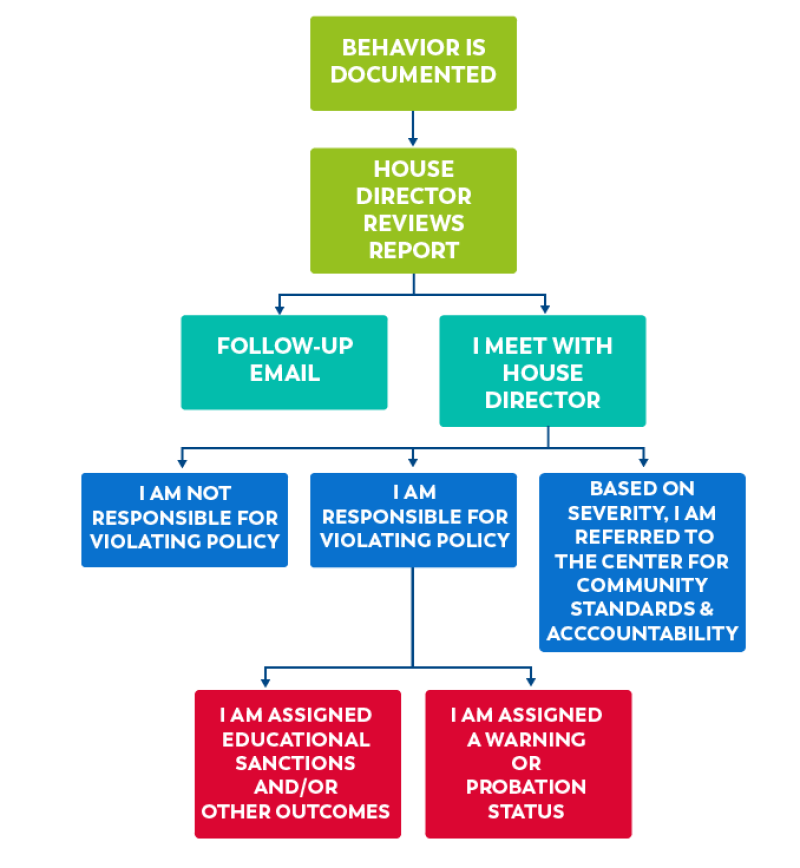
See plaintext description here. |
- Staff person becomes aware of a possible violation of standards.
- Student is notified via email that they are potentially in violation of a standard and a meeting is requested.
- Meeting is held to hear the student’s perspective and to ascertain responsibility.
- Student is notified via secure share email of determination of responsibility and sanction, if appropriate.
Rights and Obligations
A student against whom an allegation of violation is made has the following rights and obligations:
- The right to be notified within a reasonable time of the complaints against them.
- The obligation to cooperate with any investigation of complaint, including the obligation to meet with College House administrative staff, Residential Services staff, or other University officials or boards.
- The right to know the nature of any pertinent information against them.
- The right to privacy of information.
- The right to appeal any procedural concerns (i.e. due process, new information) with a Senior Director of College Houses.
Sanctions
The following sanctions are normally issued separately or in combination for violations; sanctions are accumulative and apply to a student's length of stay in College Houses:
- Informal Warning: This is a low level, introductory sanction for use in first violations and/or policy education.
- Residential Warning: This sanction is typically imposed for minor violations. A warning basically puts a student on notice and provides an opportunity to address and/or change behavior in future situations. Repeat behavior could then result in additional and retroactive sanctions.
- Educational Sanctions: Educational sanctions are used for students in situations where they would benefit from further learning about their behavior or from completing a project that allows them to engage positively with their community. Examples of such sanctions include: community service, organizing a program, doing a survey, attending a presentation, or similar projects.
- Required Move: Some situations may warrant moving a resident to a new location, either for their own benefit or for the benefit of their residential community.
- Restitution: Residents who cause damage or vandalize University property will typically be expected to pay restitution.
- Fines: Fines will be imposed for some violations as deemed appropriate based upon circumstance.
- Restriction of Privileges: Some situations may warrant a restriction of privileges, such as guest privileges or restriction from entering a specific College House.
- Referral to a University Resource Office: Students who need additional professional assistance may be referred to any number of University offices or resources.
- Parental Notification: Some situations warrant a call to a parent or guardian to discuss a student’s behavior and the impact of that behavior upon other residents.
- Residential Probation: This sanction is typically imposed for more serious violations of standards, as well as for repeated or multiple minor violations. Probation includes the potential for restriction of various College House privileges and serves as a final notice wherein future violations could result in removal from Housing.
- Removal from Housing: Removal from housing is a sanction that typically is used for serious violations of standards including endangering behavior, theft, and significant damage to property and for students who repeatedly violate policies and show no signs of changing behavior.
- Referral to the Center for Community Standards & Accountability (CSA): The College House conduct system is designed to be internal to the House system. When situations advance in severity, a House may refer a case to CSA. Cases opened by CSA may result in serious outcomes attached to a student's permanent record at Penn. CSA may also remove a student from housing. Visit the CSA website for more information.
NOTE: In situations when an individual or group poses an immediate threat to the health, safety or property of others or oneself the individual or group may be 1.) relocated on an interim or permanent basis; 2.) restricted from College Houses; or 3.) removed from University housing prior to a hearing to address the specific behaviors. The decision to remove or relocate rests with the Executive Director of College Houses or in their absence one of the Senior Directors of College Houses.